Skip to content

The Brian Lehrer Show: After Sandy: The Seminar

http://www.wnyc.org/shows/bl/2013/jun/04/after-sandy-seminar/

SRL member Liz Koslov talks about the proposed government buyouts on Staten Island, where many residents want to move rather than rebuild their homes. This research is part of her ongoing work on the politics of urban managed retreat following disasters. Liz began studying Staten Island this past semester for an NYU sociology class on cities and climate change, and is joined on the Brian Lehrer Show by professor Eric Klinenberg and doctoral student Jacob Faber, who explains his work on the uneven geography of Sandy’s impact, in terms of flooding, access to public transit and problems with electricity and sewage.

Mutual Aid Professionalization Day! June 24!

Monday, June 24, 4-7pm
20 Cooper Square
5th floor conference room

As professional movers-and-shakers, we need heat shots, blazers, black shoes, CVs and bios, among other things. Yet there isn’t always a structure to make sure those needs are met. So we are throwing a mutual aid professional swap-a-thon designed to do just that.- Get your professional portrait taken (bring any props you may need)- we have professional photographers!
– Workshop your biography and CV with others with peers
– Clothing swap those dress clothes you never wear any more- bring what you don’t wear and leave with something new
– Public speaking workshop- get advice from your peers about your presentation style and ticks

This event is open to everyone in the spirit of mutual aid– come ready to help and be helped!
Invite friends, colleagues, students, collaborators, etc. This is not just for academics– professional activists, designers, etc are welcome.

Anything else we should do?
Can you bring or do something to help out?
Contact max.liboiron@nyu.edu or post on the FB invite.

Supported by Superstorm Research Lab, a mutual aid research collective at NYU.

New google group for SRL news

If you’re interested in following what we’re up to at Superstorm Research Lab, or in other news and events related to Superstorm Sandy in NYC, we’ve created a new public, open google group: https://groups.google.com/forum/#!forum/superstorm-research-lab

Anyone is welcome to join. See you online!

Superstorm Sandy: Are We Ready for the Next One? A Conference at the Graduate Center

Communications_Header_600px_SPRING_2013_PLAIN
Superstorm Sandy: Are We Ready for the Next One?
A Conference at the Graduate Center

In three dynamic panels on public health, disaster preparedness, and scientific prediction and assessment, experts from CUNY and beyond will discuss lessons learned in the aftermath of Hurricane Sandy’s devastation. Featuring environmental and climate scientists, emergency and health management specialists, and community advocates.

Wed, May 29 / 9:00 a.m. – 1:30 p.m. / Elebash Recital Hall

Participants will include:

Dr. William Solecki, Professor of Geography; Director, Institute for Sustainable Cities, Hunter College (CUNY); and Co-Chair, Mayor’s Panel on Climate Change

Dr. William J. Fritz, Professor of Geology and Interim President, College of Staten Island (CUNY)

Dr. Nicholas Freudenberg, Distinguished Professor of Urban Public Health, Hunter College (CUNY)

And many others

FREE – first come, first served.
For more information, please call (212) 817-8215.

THE GRADUATE CENTER | 365 Fifth Avenue (at 34th Street)

SRL presenting Wednesday 5/8: Occupy Sandy and Emerging Forms of Social Organization

Description

This event is part of the Institute for Public Knowledge’s Public Forum Series on Sandy, Climate Change and the Future of New York City, organized with the Marron Institute on Cities and the Urban Environment.

This Public Forum will address Occupy Sandy and Emerging Forms of Social Organization. By a number of accounts, many neighborhoods in the immediate aftermath of Hurricane Sandy experienced confusion, disorganization, and a lack of engagement by city, state, or federal government agencies or traditional civil society groups. Occupy Sandy, however, in coordination with local neighborhood organizations, proved to be nimble, effective, and fast acting to help with the distribution of supplies and cleanup, and they continue to be deeply involved as neighborhoods are making decisions about rebuilding. What worked, what didn’t, and how are the ways in which people are organizing themselves shaping their ability to have an impact on communities? How can New Yorkers organize to effectively tackle the realities of decades of rising temperatures, moving flood lines, and intensifying storms?

Nicholas Mirzoeff is a visual culture theorist and professor in the Department of Media, Culture and Communication at New York University. He is currently working with OWS and Occupy Sandy, and on a project on the visual culture of climate change in conjunction with the not-for-profit Islands First.

Michael Ralph earned his Ph.D. in the Department of Anthropology at the University of Chicago and taught briefly in the Cornell University Department of Anthropology before joining the Department of Social and Cultural Analysis at New York University. Michael is a historical anthropologist who works on crime, citizenship, and sovereignty in Senegal and the Atlantic world, more broadly, and is a member of Occupy the SEC.

Andrew Ross is Professor of Social and Cultural Analysis at NYU, and the author of many books, including, most recently, Bird on Fire: Lessons from the World’s Least Sustainable City. He is also an organizer with Strike Debt.

The Superstorm Research Lab (SRL) will be represented by Max Liboiron, a postdoctoral fellow in the Department of Media, Culture, and Communication at New York University with the Intel Science and Technology Center for Social Computing. She is currently researching theories of scale in relation to environmental action, and, with the SRL, investigating “The Storm as a State Project.”

Harvey Molotch (moderator) is Professor of Sociology and Metropolitan Studies at New York University where he conducts research on issues of city growth and urban security as well as on product design and development. He has also researched issues in news media, the sociology of art, neighborhood racial integration, and the sociology of the environment.

The aim of this series is to engage scholars across New York University to think broadly about Superstorm Sandy, climate change, and the future of our city. All events in the series are free and open to the public, and feature scholars from a variety of departments, including Environmental Studies; Urban Planning; Sociology; Photography; Media, Culture, and Communication; Interactive Telecommunications; and Metropolitan Studies. The series is building off the conversation started at an IPK public forum in December 2012.

The Institute for Public Knowledge (IPK) brings theoretically serious scholarship to bear on major public issues. Located at NYU, it nurtures collaboration among social researchers in New York and around the world. It builds bridges between university-based researchers and organizations pursuing practical action.

NYU’s Marron Institute on Cities and the Urban Environment is a new University-wide effort to advance interdisciplinary and international research and teaching on cities and the urban environment.

photo: Sam Horine 2012

For more information, and to RSVP, click here.

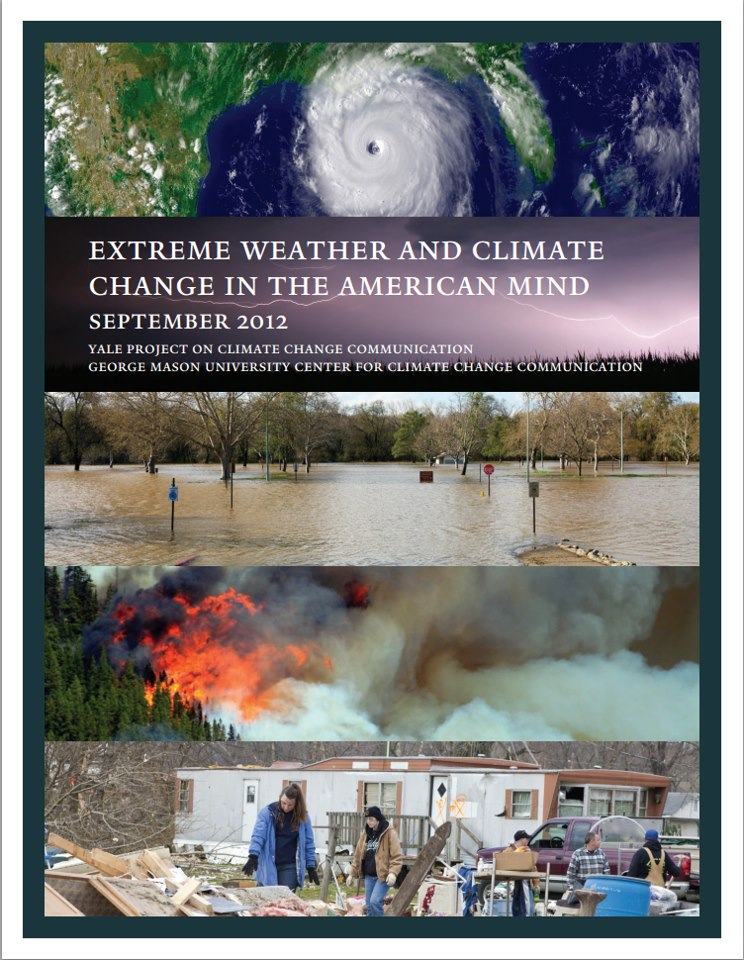
Report Released: Extreme Weather and Climate Change in the American Mind

The Yale Project on Climate Change Communication has released Extreme Weather and Climate Change in the American Mind. Free PDF here.

Highlights

  • A large and growing majority of Americans say “global warming is affecting weather in the United States” (74%, up 5 points since our last national survey in March 2012).
  • Asked about six recent extreme weather events in the United States, including record high summer temperatures, the Midwest drought, and the unusually warm winter and spring of 2011-12, majorities say global warming made each event “worse.”
  • Americans were most likely to connect global warming to the record high temperatures in the summer of 2012 (73%).
  • Americans increasingly say weather in the U.S. has been getting worse over the past several years (61%, up 9 percentage points since March).A majority of Americans (58%) say that heat waves have become more common in their local area over the past few decades, up 5 points since March, with especially large increases in the Northeast and Midwest (+12 and +15 points, respectively).
  • More than twice as many Midwesterners say they personally experienced an extreme heat wave (83%, up 48 points since March) or drought (81%, up 55 points) in the past year.
  • One in five Americans (20%) says they suffered harm to their health, property, and/or finances from an extreme heat wave in the past year, a 6-point increase since March. In addition, 15 percent say they suffered harm from a drought in the past year, up 4 points.

943196_464283790318494_1898554858_n

Today: Rethinking Homeland Security for the Age of Climate Extremes

Public Forum: Rethinking Homeland Security for the Age of Climate Extremes

Wednesday, May 1, 2013 | 6:00 pm
NYU Department of Journalism
New York University
20 Cooper Square, 7th Floor
New York, NY 10003
RSVP if you plan to attend.

This event is part of the Institute for Public Knowledge’s Public Forum Series on Sandy, Climate Change and the Future of New York City, organized with the Marron Institute on Cities and the Urban Environment.

This Public Forum will address Rethinking Homeland Security for the Age of Climate Extremes. What are the gravest threats to domestic security? In the first decade of the 21st century, the forgone conclusion for much of this nation involved a military or terrorist attack, but in the wake of Hurricane Katrina and Superstorm Sandy, as well as spikes in temperatures, wildfires and other environmentally destructive events, extreme weather events are highlighting new security vulnerabilities.

Natalie Jeremijenko is Associate Professor of Visual Art at NYU’s Steinhardt School of Culture, Education, and Human Development. Jeremijenko directs the xdesign Environmental Health Clinic. Previously she was on the Visual Arts faculty at UCSD, and Faculty of Engineering at Yale. Her work was included in the 2006 Whitney Biennial of American Art (also in 1997) and the Cooper Hewit Smithsonian Design Triennial 2006-7.

Eric Klinenberg is Professor of Sociology, and Director of the Institute for Public Knowledge at New York University. He’s also editor of the journal Public Culture, and an affiliated faculty member of the Wagner School of Public Service and the Department of Media, Culture, and Communications.

Harvey Molotch is Professor of Sociology and Metropolitan Studies at New York University where he conducts research on issues of city growth and urban security as well as on product design and development. He has also researched issues in news media, the sociology of art, neighborhood racial integration, and the sociology of the environment.

The aim of this series is to engage scholars across New York University to think broadly about Superstorm Sandy, climate change, and the future of our city. All events in the series are free and open to the public, and feature scholars from a variety of departments, including Environmental Studies; Urban Planning; Sociology; Photography; Media, Culture, and Communication; Interactive Telecommunications; and Metropolitan Studies. The series is building off the conversation started at an IPK public forum in December 2012.

photo: Sam Horine 2012

Upcoming Events

follow links to RSVP

Thursday May 02, 2013, 7:00 pm – 8:30 pm
Public Forum: Carbon and the Built Environment

Monday May 06, 2013, 7:00 pm – 8:30 pm
Book Launch | Waiting for José: The Minutemen’s Pursuit of America

Tuesday May 07, 2013, 6:00 pm – 7:30 pm
Alec Ross on Government, Technology, and Democracy in a Shifting World

Wednesday May 08, 2013, 6:00 pm – 8:00 pm
Public Forum: Occupy Sandy and Emerging Forms of Social Organization

Friday May 10, 2013, 5:00 pm – 7:00 pm
Interrupting Global Cities

Monday May 13, 2013, 6:00 pm – 8:00 pm
Public Forum: Photography and Climate Change

Tuesday May 14, 2013, 7:30 pm – 9:00 pm
Public Forum: Infrastructure

Public Forum: Housing and Hurricane Sandy

Monday, Apr 22, 2013 | 5:00 pm
Institute for Public Knowledge
New York University
20 Cooper Square, 5th Floor
New York, NY 10003
RSVP if you plan to attend.

This event is part of the Institute for Public Knowledge’s Public Forum Series on Sandy, Climate Change and the Future of New York City, organized with the Marron Institute on Cities and the Urban Environment.

This Public Forum will address Housing and Hurricane Sandy. Drawing from the recent Furman Center report on “Sandy’s Effect on Housing in NYC“, Vicki Been and Ingrid Ellen will offer their perspectives on the current state of housing in the city, and engage in a conversation about possible futures. This event will be moderated by Eric Klinenberg.

Vicki Been is the Boxer Family Professor of Law at New York University School of Law and Professor of Public Policy at New York University Wagner Graduate School of Public Service, and is the Faculty Director of the Furman Center for Real Estate and Urban Policy.

Ingrid Gould Ellen is Professor of Urban Planning and Public Policy at New York University’s Wagner Graduate School of Public Service and Co-Director of the Furman Center for Real Estate and Urban Policy.

Eric Klinenberg (moderator) is Professor of Sociology, and Director of the Institute for Public Knowledge at New York University. He’s also editor of the journal Public Culture, and an affiliated faculty member of the Wagner School of Public Service and the Department of Media, Culture, and Communications.

The aim of this series is to engage scholars across New York University to think broadly about Superstorm Sandy, climate change, and the future of our city. All events in the series are free and open to the public, and feature scholars from a variety of departments, including Environmental Studies; Urban Planning; Sociology; Photography; Media, Culture, and Communication; Interactive Telecommunications; and Metropolitan Studies. The series is building off the conversation started at an IPK public forum in December 2012.

The Institute for Public Knowledge (IPK) brings theoretically serious scholarship to bear on major public issues. Located at NYU, it nurtures collaboration among social researchers in New York and around the world. It builds bridges between university-based researchers and organizations pursuing practical action.

NYU’s Marron Institute on Cities and the Urban Environment is a new University-wide effort to advance interdisciplinary and international research and teaching on cities and the urban environment.

Sandy, Climate Change and the Future of New York City

sandy-forum-spring2013

The Institute for Public Knowledge is organizing a Public Forum Series on Sandy, Climate Change and the Future of New York City with the Marron Institute on Cities and the Urban Environment. The aim of this series is to engage scholars across New York University to think broadly about Superstorm Sandy, climate change, and the future of our city. All events in the series are free and open to the public, and feature scholars from NYU departments including Environmental Studies; Urban Planning; Sociology; Photography; Media, Culture, and Communication; Interactive Telecommunications; and Metropolitan Studies. The series is building off the conversation started at an IPK public forum in December 2012.

April 22, 5PM Housing and Hurricane Sandy
Vicki Been & Ingrid Gould Ellen

April 26, 6PM Technology, Art, and Disaster
Jacques Servin & Marina Zurkow

May 1, 6PM Rethinking Homeland Security for the Age of Climate Extremes
Eric Klinenberg & Harvey Molotch

May 8, 6PM Occupy Sandy and Emerging Forms of Social Organization
Max Liboiron and Superstorm Research Lab, Nick Mirzoeff, Michael Ralph & Andrew Ross

May 13, 6PM Photography and Climate Change
Mark Bussell, Fred Ritchin & Joseph Rodriguez

May 14, 7:30PM Infrastructure
Mitchell Joachim, Constantine Kontokostan & Rae Zimmerman

The Institute for Public Knowledge (IPK) brings theoretically serious scholarship to bear on major public issues. Located at NYU, it nurtures collaboration among social researchers in New York and around the world. It builds bridges between university-based researchers and organizations pursuing practical action.

NYU’s Marron Institute on Cities and the Urban Environment is a new University-wide effort to advance interdisciplinary and international research and teaching on cities and the urban environment.

Part-time transcriber sought for SRL

Superstorm Research Lab, a group of NYU researchers investigating the impacts of Hurricane Sandy on New York City, is seeking a part-time transcriber to convert audio recordings of interviews into written transcriptions. The posting is open to all NYU students—undergraduates or graduates.

The work begins immediately, and can continue through the summer into the fall. The workload will vary week to week depending on the number of interviews conducted, but will generally be between 1 and 10 hours. The pay is $12/hr, and candidates who have work study for the spring or fall will be paid through work study.

Interviews are approximately one hour long. Most are in English, but some will be in either Spanish or Russian, so fluency in these languages is a plus. We cannot provide transcription equipment (headsets and foot pedals).

Please email your CV and cover letter to jessica.coffey@nyu.edu. In your cover letter, please address the following:

– Any previous experience you have with transcription
– Whether you are able to transcribe and translate from either Spanish or Russian
– Whether you have access to transcription equipment
– The number of hours a week you will be available to work in the spring, summer, and fall
– Whether or not you have work study in the spring or fall

Superstorm Research Lab is an award-winning group of NYU researchers. Our goal is to explore narratives about three substantive topics of contemporary concern—inequality, climate change, and urban governance—and their relationships to one another within the context of Hurricane Sandy. Our principal method is to interview stakeholders from across the city—policy actors in different state agencies, engaged business people, members of relevant NGOs and other civil society institutions, volunteer first responders, and residents of affected areas, especially in Coney Island. We are online at http://superstormresearchlab.org.

SRL @ AAG

Several members of the Superstorm Research Lab will be at the Association of American Geographers conference next week in LA. As in other years, the Hazards, Risks and Disaster Specialty group is holding a number of panels, and there are a many environmental justice panels that may be of interest to people whose work parallels SRL:

There are six papers specifically on Superstorm Sandy (not presented by SRL members):

From dangling cranes to flooded tunnels: Hurricane Sandy and the Geographies of Twitter
Friday, 4/12/2013 at 14:40 PM

Print News Patterns and Hurricane Sandy (2012)
Wednesday, 4/10/2013 at 12:40 PM

Tracking Hurricane Sandy (2012) through Newspaper Photography
Wednesday, 4/10/2013 at 12:40 PM

The Impact of Hurricane Sandy on selected south coast beaches, Jamaica, West Indies.
Saturday, 4/13/2013 at 16:00 PM

Community-based Flood Preparation and Damage Assessment – Hurricane Sandy
Wednesday, 4/10/2013 at 8:00 AM

The Influence of Climate Anomalies on the Development, Sequence and Outcome of Hurricane Sandy
4/11/2013 at 12:40 PM

SRL member presentations and panels (note some are explicitly about Superstorm Sandy and some are not). Please feel free to meet with us if you are interested in our SRL work:

Scale, Action, and the Environment: Superstorm Sandy
Max Liboiron
Wednesday, 4/10/2013, from 10:00 AM – 11:40 AM in Malibu Parlor 3118, Westin, 31st Floor

Geographies of Garbage: the State of the Art on Discard Studies.
Max Liboiron
Thursday, 4/11/2013, from 4:40 PM – 6:20 PM in Pico, The LA Hotel, Level 2
This panel is not about Superstorm Sandy in particular, but “disaster trash” will be mentioned.

Future of the Capitalist City
Daniel Aldana Cohen (“Climate Change, “post-materialism”, and the future of the capitalist city“) and Max Besbris
Thursday, 4/11/2013, from 2:40 PM – 4:20 PM in Corsican, Biltmore, Mezzanine Level
Climate change is one of the areas of research is SRL, and Daniel will examine the class contradictions of  existing urban climate politics in New York and São Paulo.

The Political Ecology of Urbanization
David Wachsmuth
Wednesday, 4/10/2013, from 10:00 AM – 11:40 AM in Pico, The LA Hotel, Level 2
This paper offers some thoughts on a research agenda for a political ecology not of the city but of urbanization.

Megaregions 1: Structures, Functions, Patterns
David Wachsmuth
Thursday, 4/11/2013, from 8:00 AM – 9:40 AM in Olvera, The LA Hotel, Level 2
David is the disscussant for this panel, and will be drawing from SRL’s current research in his discussion.

Grant: Emerging Crises Oral History Research Fund

The Oral History Association announces a grant of up to $3,000 to undertake oral history research in situations of crisis research in the United States and internationally. These funds may be applied to travel, per diem, or transcription costs for research in places and situations in which a longer application time schedule may be problematic. Such crisis situations include but are not limited to wars, natural disasters, political and or economic/ethnic repression, or other currently emerging events of crisis proportions.

Applications should be formatted in Microsoft Word and sent electronically by April 1, 2013, to: oha@gsu.edu.

While membership in the Oral History Association is not required, it will be appreciated if you choose to affiliate with OHA, thus supporting its ongoing efforts to enhance the use of oral history historical methods in academic research.

Application Guidelines

1. To apply for a grant, applicants should submit the following materials:

  • A one-page research proposal that addresses the importance and scope of the project. Applicants should explain the nature of the emerging crisis they are researching, provide details about the interviews planned, and suggest arrangements for preserving the interviews and making them accessible for future use.
  • A research budget that demonstrates how the grant funds will be spent. Typically, funds will be spent for travel, per diem, and/or transcription costs, although other reasonable expenses associated with oral history research may be considered. Equipment purchases, however, will not be allowed. A brief justification of all budget items should be included.
  • A current curriculum vitae should also be included.

2. The Emerging Crises Oral History Research Fund Committee will review applications and forward its recommendations to the Oral History Association, which will make the award(s).

3. The Committee will make its recommendations within four weeks after the application due date.

Mission Statement

Oral history research includes important projects that address current crisis situations in both the United States and internationally, including wars, natural disasters, political and economic/ethnic repression, or other current events of crisis proportions. Scholars conducting oral history research on these types of projects often begin interviewing informants within weeks or months of the crisis or even while the crisis event is unfolding. Obtaining funding for such research is generally difficult because of the extended application time schedule of most funding organizations.

The Research Fund is designed to provide a more expedient source of funding for these meaningful projects through an application process that is brief and that has a quick turnaround between the time of application and a decision on the receipt of funding.

For additional information, please contact:
Mark Cave
Chair, Emerging Crises Oral History Research Fund
Oral History Association
e-mail: markc@hnoc.org
phone: 504-598-7132

Additional Information

Source: http://www.oralhistory.org/award/emerging-crisis-research-fund/.

NYU Law Alt Spring Break on workers’ rights issues in Sandy-affected areas

Spring Break is almost here! Are you looking for a way to promote rights and make a difference over Spring Break without leaving NYC? Volunteer with NYU Law’s Global Justice Clinic! The Global Justice Clinic is seeking volunteers, preferably Spanish speakers, to assist in a study on rights violations of construction workers in Sandy-affected areas of NYC. The project examines the experiences of construction workers on issues of job security, safety, fair pay, discrimination and access to adequate housing and healthcare, in order to collect valuable data to support the advocacy work of local community organizations in the fields of labor and immigrant rights.

Over Spring Break, volunteers will receive 2 days of training (March 17–18) in conducting interviews with participants. Then they will travel in pairs to Sandy-affected areas in NYC to survey construction workers on-site for 2–3 days (between March 19–23). Each interview will take approximately 30 minutes and survey teams will record answers on PDAs. The data will be analyzed by us and our collaborators and we will share our findings with you so you can see what your volunteer efforts helped produce.

For more information or to express your interest, please contact: Anji Manivannan (am4800@nyu.edu) or Julia Freidgeim (jf2544@nyu.edu).


Julia Freidgeim

LLM Candidate, 2013
New York University School of Law

Superstorm Research Lab presenting at Nature, Ecology and Society Colloquium 3-8-13

srl-logo-print.jpg

will present:
“The Potential for Spatial and Temporal Restructuring of Action After Sandy”
at
CUNY’s Twelfth Annual Nature, Ecology and Society Colloquium:
SuperStorm Sandy: Before, During & After
March 8th, 2013
Martin E. Segal Theater, CUNY  Graduate Cener
365 5th Ave  New York, NY 10016

About the presentation:

One of the major dilemmas facing contemporary urban governance and environmental action in the United States is the mismatch between inherited political boundaries and emerging sociospatial urban realities. This project investigates what impact an event such as Sandy can have on such structures. The common assumption is that a heroic policy, NGO, or popular effort will be needed to transform inherited structures to overcome these mismatches. This project instead investigates what impact an event can have on such structures. In Sewell’s (2005) terms, events are the fateful collective contingencies that interrupt the reproduction of structures. In the literature on crises and disasters, this is a familiar way to understand the unexpected and transformative impact such events can have on “business as usual”, and this project applies these insights to the impact of Hurricane Sandy on the structure of urban politics in the New York City area.

This paper is based on preliminary research with the Superstorm Research Lab collective. Based on interviews with policy actors, NGOs, first responders, and residents of affected areas, we ask how Sandy has potentially restructured patterns of governance and action based on stakeholder understandings of critical processes following Sandy.

About the Colloquium:

Hurricane Sandy had drastic impacts on 29 October, 2012. This year’s Nature Ecology Society Colloquium is intended to open up a conversation around Hurricane Sandy. We recognize that politics play a part in this conversation, that there are complex social and environment justice issues that have and need to be understood, and that there must be a rebuilding effort that is sensitive to all of these aspects. We hope this colloquium can be a space where presenters will openly interrogate these and other issues.

The Nature, Ecology and Society Network is the City University of New York’s (CUNY) Interdisciplinary Network for researchers, activists and other colleagues whose work is at the intersection of Nature Ecology and Society.

Full schedule is here.

Register here. 

Investing in Disaster Preparedness, Response and Recovery

???????????????????????????????????????????????????????????????????????????????????????????????????????????????????????????????????????????????????????????????????????????????????????????????????????????????????????????????????????????????????????????????????????????????????????????????????????????????????????????
THURSDAY, MARCH 7, 2013
Panel discussion + social hour 6:30-9:30pm

32BJ SEIU – 25 West 18th Street, 5th Floor Conference Room
(between 5th & 6th Aves) New York, NY

Co-sponsors: 32BJ SEIU, DC37/AFSCME, Public Services International, The Worker Institute at Cornell

Trade unionists, community leaders and United Nations agency and national delegation representatives are invited to a special meeting to network and discuss critical disaster preparedness, response and recovery issues. In the wake of Superstorm Sandy, this is an opportunity to share experiences, lessons learned and best practice proposals for solutions.

With speakers from: 
32BJ SEIU
District Council 37/AFSCME, Henry Garrido
Public Services International, Rosa Pavanelli
TWU Local 100
UWUA Local 1-2, John Duffy
ALIGN, Matt Ryan

Your views are important. We look forward to having you join in the discussion on how we can strengthen professional expertise, public services and community capacity for better disaster resilience.

Please RSVP to Mark Langevin:  Mark.Langevin@world-psi.org
Jon Forster: 4unionnow@gmail.com


This is not an SRL event.

SRL at Nature, Ecology and Society Colloquium March 8th

Superstorm Research Lab will be presenting some of our preliminary findings at CUNY’s Nature, Ecology and Society Colloquium.

Screen-Shot-2013-02-09-at-12.54.06-PM

Our presentation will be on:

The Potential for Spatial and Temporal Restructuring of Action After Sandy

One of the major dilemmas facing contemporary urban governance and environmental action in the United States is the mismatch between inherited political boundaries and emerging sociospatial urban realities. This project investigates what impact an event such as Sandy can have on such structures.

This paper is based on preliminary research with the Superstorm Research Lab collective. Based on interviews with policy actors, NGOs, first responders, and residents of affected areas, we ask how Sandy has potentially restructured patterns of governance and action based on stakeholder understandings of critical processes following Sandy such as contamination, climate change, debt, and governance.

Schedule and other details to follow.

NYC’s Post-Sandy Recovery: How’re We Doin’?

AIA New York Center for Architecture
AIA CES: 1.5 LUs | 1.5 HSW || LACES: 1.5 NYS LA CEUs | 1.5 HSW
When: 6:00 PM – 8:00 PM WEDNESDAY, FEBRUARY 13
Where: Center for Architecture
536 LaGuardia Place
New York, NY 10012
phone: 212.683.0023
fax: 212.696.5022
info@aiany.org

Three months after the ravages of Superstorm Sandy, this program brings together government and civic leaders to both report on the status of the recovery of the New York City region and to discuss the effectiveness of the recovery efforts. The session will provide an opportunity to evaluate housing, neighborhood and open space clean-up and rebuilding initiatives.

Last October 21st, AIANY’s Design for Risk and Recovery Committee fielded a similarly-constituted panel at the Center for Architecture to address the question: “After Disaster: How Does New York Plan to Recover?” Only eight days later, Hurricane Sandy delivered a natural disaster that has given New York an unprecedented challenge to the disaster-recovery systems that were described. How well do you think they worked? What now?

DfRR has become the center of the Chapter’s focus on disaster awareness and preparedness. It is a full-spectrum committee comprised of architects, planners, landscape architects, engineers, and related professionals – a source for information, discussion, connections, and the most advanced thinking on risk, mitigation, and resilience.

Welcome:
Lance Jay Brown, FAIA, DPACSA
Illya Azaroff, RA, AIA

Co-Chairs, AIANY Design for Risk and Reconstruction Committee

Moderator:
Denisha Williams, RLA, LEED AP
Immediate Past President, New York Chapter of the American Society of Landscape Architects

Speakers:
Erica Keberle
Deputy Director of the Mayor’s Office of City Legislative Affairs
NYC Rapid Repairs, External Affairs

Bram Gunther
Chief, Forestry & Horticulture and Natural Resources Group
New York City Department of Parks and Recreation

Thaddeus Pawlowski
Associate Urban Designer, Office of the Chief Urban Designer
New York City Department of City Planning

Anthony C. Romeo, AIA
Parks Program Director
New York City Department of Design and Construction

Dean Sakamoto, FAIA, LEED AP
Urban Resilience Lab
University of Hawaii at Manoa
Ronald Schiffman, FAICP, Hon. AIA
Professor, Pratt Graduate Center for Planning
Pratt Center for Community Development

Cost:
Free for AIA and ASLA members and students
$10 for Non Members

Particpants will have the opportunity to make contributions to the Mayor’s Fund to Advance New York City to support Superstorm Sandy relief efforts.The Mayor’s Fund retains no administrative fee, and one hundred percent of donations are being dispersed to relief efforts and organizations. Funds will support immediate aid needs – including, food, water and hygiene supplies – as well as long-term relief and restoration.

Organized by: AIA Design for Risk and Reconstruction Committee (DfRR) and the American Society of Landscape Architects New York Chapter

Sandy Victims Protest BRC Headquarters

Friday Feb. 15 at 3:30 PM
131 W 25th St btw 6th & 7th Aves.
 
Transit:  #1, 2, 3 train to 23 St (at 7th Av); F, M, PATH to 23 St. (at 6th); N, R to 23 St. (at Broadway); #4, 5, 6 to 23 St. (at Park Av. So.); buses via 6th or 7th Av.; M23 cross town bus via 23rd St. <http://goo.gl/maps/rnIf3>
347 265 5003646 265 5003  eisaacs66@gmail.com
The newest hardship Sandy victims in Manhattan hotels are facing is eviction into homeless shelters. The agency that the city contracted to case manage victims is BRC, the group that usually picks up chronically homeless people from the streets and puts them in shelters. They have actually offered no help to Sandy survivors — they probably don’t even know anything about low income stable housing. They have been treating people extremely rudely and threateningly.

Now they are systematically telling people they have to leave their hotel (before their previously given check out dates) and go to shelters, one by one. No one knows for sure if they are initiating this tactic, or if it is the hotels or the city. So far 3 families have been removed.

This leaves the families in yet another borough where their children have to change schools again, where they are treated like prisoners, and where the environment is often unsafe. Others are planning to resist removal. A campaign to notify politicians and the press is underway, although that is probably useless given their previous unresponsivenes.

Victims and supporters are holding a demonstration Friday at BRC headquarters at 3:30 PM

For more info call Errol a 347 2655003 or Ellen 646 2655003
(This is not a SRL event)

Is Sandy the New “Normal”?

A TALK WITH CHRIS WILLIAMS ABOUT THE ROOTS OF CLIMATE CHANGE AND THE FIGHT FOR CLIMATE JUSTICE
https://www.facebook.com/events/162870190527163/
Thursday 8pm-10pm
Hamilton Rm: 703, Columbia University
From Hurricane Sandy to the devastating effects of fracking, the exploitation of our environment is driving outcomes like climate change and increasing numbers of “natural” disasters. Join us in a discussion with Chris Williams, author of the highly acclaimed book “Ecology and Socialism” about the man-made factors contributing to these unsustainable changes and how activists can organize for a different kind of society that prioritizes the sustainability of our environment.

Superstorm Sandy: Before, During and After

The 12th Annual Nature Ecology Society Colloquium (opencuny.org/nature) at the CUNY Graduate Center
Hosted by the Environmental Psychology PhD Program
Colloquium Date: March 8, 2013                                                                                           Deadline for Proposals: February 8, 2013                                                                             

Hurricane Sandy had drastic impacts on 29 October, 2012. This year’s Nature Ecology Society Colloquium is intended to open up a conversation around Hurricane Sandy. We recognize that politics play a part in this conversation, that there are complex social and environment justice issues that have and need to be understood, and that there must be a rebuilding effort that is sensitive to all of these aspects. We hope this colloquium can be a space where presenters will openly interrogate these and other issues.

The Nature, Ecology and Society Network is the City University of New York’s (CUNY) Interdisciplinary Network for researchers, activists and other colleagues whose work is at the intersection of Nature Ecology and Society. We aim to continue the tradition of creating a space for interdisciplinary conversation at NES2013 by requesting proposals from CUNY and allied Students, Artists, Activists, Designers, Journalists, Musicians, Performers, Film and Video Makers, Humanities Scholars, and Life, Natural, Physical and Social Scientists.

Presentation Submission Guidelines

NES 2013 invites proposals for two kinds of presentations: Oral Presentations (15 minutes followed by 5 minutes for questions) describing scholarly, activist, or volunteer work relating to Hurricane Sandy, and Panel Presentations (45 minutes followed by 15 minutes for questions) of three or more presenters addressing Hurricane Sandy related issues from multiple perspectives and/or methodologies.

Oral Presentation Proposals: Please include your name, project title, affiliation(s), and an abstract (100 words) outlining the presentation.

Panel Presentation Proposals: Please include the names of all panel presenters and their affiliations, a panel title, individual presentation titles, an abstract from each presenter (100 words), and a rationale (100 words) for the panel discussion. Please also choose a panelist to serve as the contact person and please provide their contact information.

All proposals should be submitted to the NES 2013 RFP online form. Following the selection process, applicants will be notified by February 14th. Due to time and space constraints, we may not be able to schedule every submission. Please contact natureecologyandsociety@gmail.com with questions. 

Thank you!
Colloquium Co‐Organizers
Bryce DuBois, PhD Student in Environmental Psychology
Scott Fisher, PhD Student in Environmental Psychology
Laurie Hurson, PhD Student in Environmental Psychology
Hannah Jaicks, PhD Student in Environmental Psychology
Bijan Kimiagar, PhD Student in Environmental Psychology
Do Lee, PhD Student in Environmental Psychology
Mariya Marinova, PhD Student in Environmental Psychology
Jennifer Pipitone, PhD Student in Environmental Psychology
Melissa Zavala, PhD Student in Anthropology

Faculty Advisor
David Chapin, M. Arch: Environmental Psychology

The Graduate Center, CUNY, 365 Fifth Avenue, New York, NY 10016 USA